 blog
blog
Sterling Silver vs Gold Plated Charm Bracelets
Table of Contents
- Sterling Silver vs Gold Plated Charm Bracelets: What Actually Differs
- Durability and Longevity: Which Finish Lasts Longer
- How to Care for Sterling Silver Jewelry
- How to Care for Gold Plated Jewelry
- Mixing Silver and Gold Jewelry on One Bracelet
- Cost, Value, and How to Spot Real Sterling Silver
- Which Finish Suits Your Lifestyle and Budget
- Conclusion: Choosing Between Sterling Silver and Gold Plated Charm Bracelets
- Frequently Asked Questions
Last Updated: October 6, 2026
Sterling Silver vs Gold Plated Charm Bracelets: What Actually Differs
The choice between sterling silver vs gold plated charm bracelets comes down to how each finish behaves over years of wear.
How Each Metal Is Made
Sterling silver is an alloy of 92.5% silver and 7.5% other metals, usually copper, which adds strength without dulling brightness.
Gold plated jewelry works differently: a base metal, often brass or copper, gets a thin layer of gold bonded to its surface through electroplating.
The U.S. Federal Trade Commission's jewelry advertising guidance sets out how terms like "gold plated" must be described, which is worth knowing when you're comparing labels.
Quick Comparison Table
| Factor | Sterling Silver | Gold Plated |
|---|---|---|
| Base material | Solid 92.5% silver alloy | Base metal with thin gold layer |
| Wears through? | No, polishes back to shine | Yes, at friction points |
| Tarnish risk | Yes, cleanable | Plating can flake or fade |
| Best for | Daily wear, long-term pieces | Occasional wear, gold tone on a budget |
| Repair options | Repolish indefinitely | Replating may be possible |
Durability and Longevity: Which Finish Lasts Longer
Durability is not a property of the metal name on the label. It is the product of four variables: material, construction, wear and care, and consistency of making. Change any one and the same material can last two years or twenty.
The Four Variables That Decide How Long a Bracelet Lasts
1. Material. Sterling silver is a solid 92.5% silver alloy, so there is no surface layer to wear through.
2. Construction. This is where most bracelets actually fail. A bracelet's weak points are its joints, not its metal: the clasp, jump rings, soldered connections, and charm loops.
**3.
4. Quality control. In high-volume production, consistency comes from process control rather than per-piece attention.
How Sterling Silver Actually Ages
Sterling silver does not wear out; it tarnishes. Exposure to air, moisture, and sulfur compounds creates a dark surface film, removable with a soft cloth or gentle silver polish. The metal underneath is unchanged, and repeated polishing removes only microscopic amounts of silver over many years.
A common mistake is reading tarnish as a sign of low quality. Tarnish is a normal chemical reaction that says nothing about the silver's purity, and it reverses easily.
How Gold Plating Actually Ages
Gold plating ages by thinning, fastest where the bracelet touches things: the clasp, the underside of the band, the charm loops, and any point that rubs against skin or a desk.
What most guides miss is that plating thickness matters more than the gold's karat rating. A thicker layer of lower-karat gold generally outlasts a thinner layer of higher-karat gold, because the failure mode is mechanical wear, not chemical purity.
How to Compare Two Bracelets Before You Buy
- Check the joints first. Soldered links, a clasp with a safety catch, and welded charm attachments extend lifespan regardless of metal.
- Ask about plating thickness on gold plated pieces. A stated micron figure is a good sign; silence is not.
- Look for a hallmark on sterling silver: "925" or "sterling" stamped on the clasp or band.
- Match the finish to your habits. If you never take your bracelet off, choose solid metal. If you rotate accessories weekly, plating has far less opportunity to wear through.
How to Care for Sterling Silver Jewelry
Caring for sterling silver jewelry comes down to two habits: keep it dry and keep it sealed. Silver tarnishes fastest in humid air, so the pieces you wear least need the most protection.
Everyday Habits That Prevent Tarnish
- Put bracelets on last, after lotions, perfume, and hairspray have dried.
- Take them off before swimming, showering, or washing dishes.
- Wipe each piece with a soft cloth before it goes back in storage.
- Rotate your stack so no single bracelet sits untouched for months.
Cleaning and Storage
For light tarnish, a silver polishing cloth handles most of it; for heavier buildup, a gentle silver dip followed by a rinse and thorough dry works well. Store pieces in an anti-tarnish pouch or lined box with the clasp closed.
How to Care for Gold Plated Jewelry
Caring for gold plated jewelry means protecting the layer, not restoring it. Once plating wears through, no cloth or polish brings it back, so prevention is everything.
What to Avoid
- Abrasive polishes and rough brushes, which strip the gold layer
- Perfume, sunscreen, and hairspray applied directly to the bracelet
- Chlorine and salt water, both of which attack plating
- Stacking a plated bracelet against heavier metal charms that grind against it
When Replating Makes Sense
Replating is worth considering for a sentimental piece where the setting and stones still hold up. It rarely makes sense for a low-cost bracelet, since replating can approach the price of a new plated piece. Ask a jeweler to assess the base metal first; if it's corroded, replating won't hold.
Mixing Silver and Gold Jewelry on One Bracelet
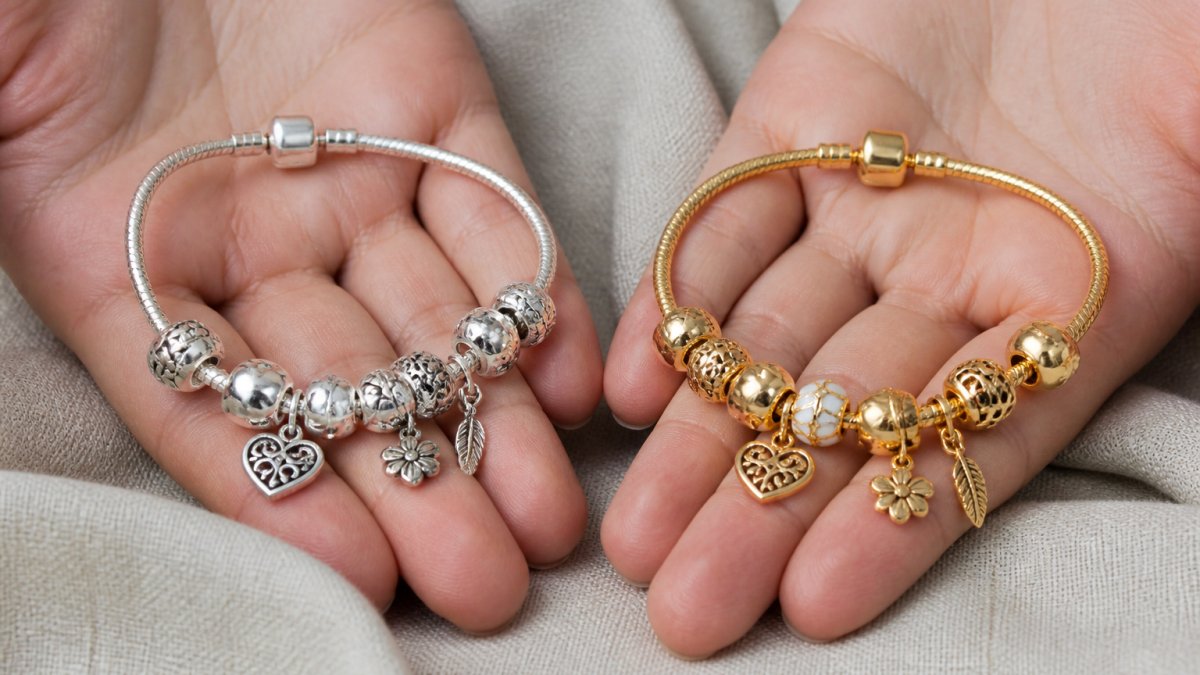
Mixing silver and gold jewelry on one bracelet is entirely a design choice, and mixed-metal stacks have become a staple look. The trick is balance, not matching.
Balancing Two Metals in a Single Stack
- Anchor the stack with one dominant metal, then add the second as an accent.
- Repeat each metal at least twice so the mix looks intentional.
- Use a warm-toned charm between cool silver beads to bridge the two.
- Keep finishes consistent: all polished or all brushed, not both.
If you're building a mixed-metal bracelet, choose a clasp and core chain in the metal you wear most, then let the charms carry the contrast. That way the piece still reads as one design rather than two competing ones.
Cost, Value, and How to Spot Real Sterling Silver
Price differences between sterling silver and gold plated charm bracelets come from four inputs: raw material, the labor and skill required to work it, design and finishing time, and the maker's production volume.
What Drives the Price of Each Finish
Raw material. Sterling silver contains 92.5% silver by weight, a metal with real market value that fluctuates daily.
Design and finishing. Hand-finishing, individual polishing, and per-piece inspection all add cost, as does design work not repeated across thousands of identical units.
Production volume. A factory making ten thousand identical bracelets spreads setup, tooling, and design costs across all of them.
Upfront Cost Versus Value Over Time
The honest framing is not "sterling silver is better value", the two finishes front-load and back-load their costs differently.
A sterling silver bracelet costs more on day one, but it can be polished back to life indefinitely and often repaired rather than replaced.
A gold plated bracelet costs less on day one, and for many wearers that is the entire point.
When Gold Plated Is Genuinely the Better Buy
A balanced comparison has to say this plainly:
- Trend-led pieces. If the design will feel dated in a year, paying for solid metal is paying for longevity you will not use.
- Occasional or event wear. A bracelet worn a few times a month sees very little friction, so plating has little opportunity to wear through.
- Testing a style. If you are unsure whether you like the gold tone against your skin, a plated piece is a low-commitment way to find out.
- Gift pieces for uncertain tastes. When you do not know the recipient's habits, a lower-commitment piece is often the kinder choice.
- Building a large, rotating collection. If no single bracelet gets daily wear, the durability advantage of solid metal is largely unused.
How to Verify Sterling Silver and Gold Plated Claims
For sterling silver, look for a hallmark stamp reading "925" or "sterling" on the clasp, the band, or a small tag. The U.S.
For gold plated pieces, the most useful detail is plating thickness. A stated micron figure tells you how much gold is actually there; a listing that says only "gold plated" with no thickness tells you very little.
Questions Worth Asking Any Seller
- Is the sterling silver hallmarked, and where is the stamp located?
- For plated pieces, what is the plating thickness, and over what base metal?
- Are the links soldered and the charm attachments welded?
- Can the piece be repaired or replated later, and does the maker offer that service?
Which Finish Suits Your Lifestyle and Budget
Match the finish to how you'll actually wear the bracelet, not to what looks best in a photo. Someone who wears one bracelet daily and never takes it off will get more from sterling silver. Someone who swaps accessories constantly and wants a gold tone for a specific outfit can do very well with plating.
- Daily wear, shower-and-sleep-in-it piece: sterling silver, because it survives and restores.
- Occasional statement piece: gold plated, because the gold tone is the point.
- Sentimental milestone bracelet: sterling silver, because it's meant to last decades.
- Trend-driven stack you'll rotate often: either works, so let the design lead.
If you're switching from a plated bracelet to sterling, expect a slightly cooler tone and a bit more weight. That difference is the solid metal.
Conclusion: Choosing Between Sterling Silver and Gold Plated Charm Bracelets
Neither finish is objectively better; they solve different problems. Sterling silver wins on longevity and repairability, while gold plating wins on upfront cost and that warm gold look without the gold price.
At Handmade Pandora-Style Charm Bracelets, we work with high-quality alternative components including Gona Paris designs with white and gold plating. Sign in to start building a bracelet that fits how you actually wear it.
Frequently Asked Questions
Which lasts longer, sterling silver or gold plated charm bracelets?
Sterling silver typically lasts longer because it is a solid alloy throughout. Gold plated charms have a thin layer of gold over a base metal, and that layer wears away with friction, sweat, and cleaning. A well-cared-for sterling silver bracelet can stay wearable for decades, while gold plating usually needs replating after extended daily wear. Longevity depends heavily on how often you wear the piece and how you store it.
Does gold plating wear off charm bracelets?
Yes, gold plating does wear off over time. The layer is measured in microns, and repeated contact with skin, clothing, and moisture gradually thins it. Areas that rub most, such as clasps and the undersides of charms, show wear first. You can slow this by removing gold plated jewelry before showering, swimming, or applying lotion, and by storing each piece separately to avoid scratches.
Can you mix sterling silver and gold plated charms on one bracelet?
You can, and two-tone charm bracelets have become a popular style. Check that the charms share a similar bail size and weight so the bracelet hangs evenly. Keep plated charms away from polishing cloths meant for silver, since abrasive cleaners can strip the gold layer. If you plan to mix metals often, choose a sterling silver chain as the base because it handles wear better than a plated chain.
How can you tell if a charm bracelet is real sterling silver?
Look for a hallmark stamped on the clasp, the chain, or the back of a charm. Common marks include 925, STERLING, or Sterling Silver. Sterling silver is 92.5 percent silver, so it feels denser than plated base metal of the same size. A magnet will not stick to solid sterling silver, though it may attract the spring in a clasp. When buying online, ask the seller to confirm the hallmark in writing.