 how-to
Can You Add Charms to Any Bracelet? A Complete Guide
Table of Contents
- Understanding Bracelet Compatibility: Which Styles Accept Charms
- How to Attach a Charm to a Bracelet: DIY Methods
- Non-Pandora Charms on a Pandora Bracelet: What You Need to Know
- Charm Bracelet with Soldered Links: Permanent Attachment Options
- Bracelet Charm Placement: Where to Position Your Charms
- When to Visit a Jeweler vs. DIY Attachment
- Common Mistakes to Avoid When Adding Charms
- Frequently Asked Questions
Last Updated: October 9, 2026
Understanding Bracelet Compatibility: Which Styles Accept Charms
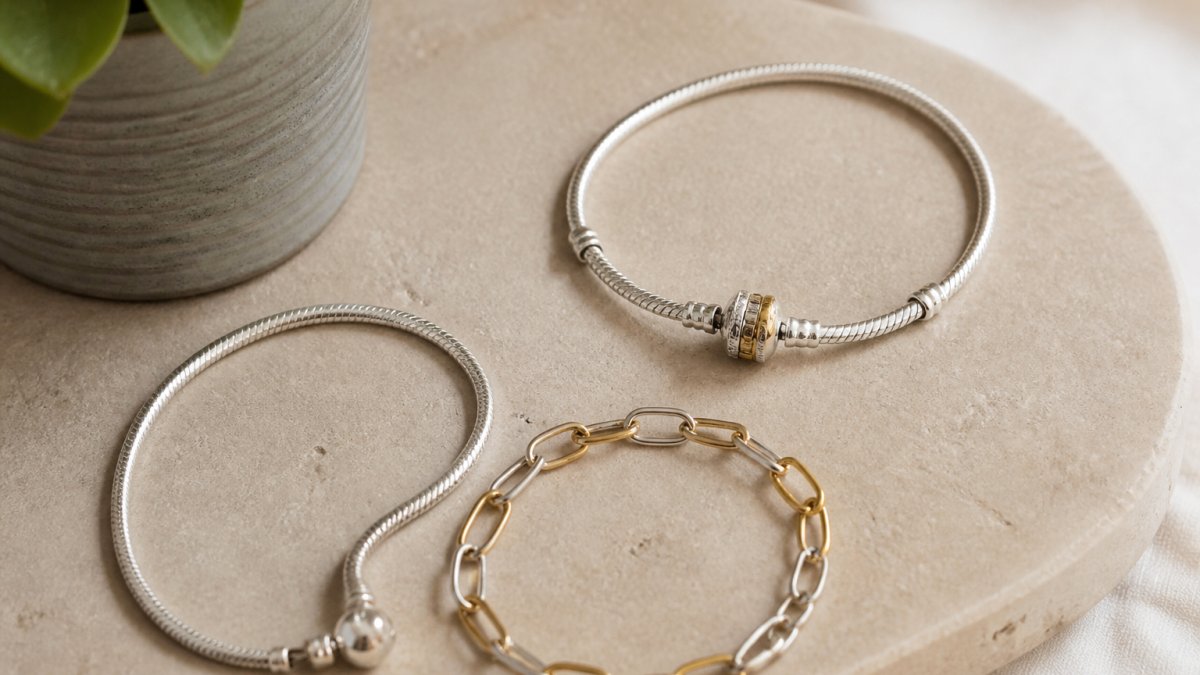
Not every bracelet can hold charms, the deciding factor is the attachment hardware, not the style name. Two identical-looking bracelets can behave completely differently once you hang a charm, because one has a soldered loop rated for weight and the other a decorative link never meant to carry anything.
At Handmade Pandora-Style Charm Bracelets, customers constantly ask whether they can add charms to any bracelet. The honest answer: it depends on what the bracelet was engineered to do, whether the structure allows it safely.
The three attachment mechanisms that matter
Before you buy a charm or pick up pliers, identify which mechanism your bracelet uses. Everything else follows from that.
1. Dedicated charm loops (or soldered jump rings). Small metal loops fused onto the chain at regular intervals.
**2.
3. Clasp and closure hardware. Barrel clasps, screw closures, and hinged bangles sometimes have a small loop a jump ring can pass through.
Bracelet-by-bracelet compatibility
Here is how common bracelet types behave when you add a charm.
Chain bracelets with soldered links or charm loops. Best case, designed for this.
Plain chain bracelets without dedicated loops. Workable if the chain is substantial.
Solid bangles (no hinge, no loop). No attachment point exists, and a jump ring cannot pass through solid metal.
Hinged bangles. Sometimes have a small loop near the hinge. If so, a jump ring works.
Bracelets with limited or no charm capacity
Some bracelets should not carry charms, no matter how careful you are:
- Solid metal bangles with no loop or hinge
- Thin wire bracelets under roughly 1mm, which bend under charm weight
- Stretch bracelets without built-in spacers, because the elastic fatigues
If your bracelet falls into one of these categories, the realistic options are a clip-on charm, a jeweler-added soldered loop, or a different bracelet for your charm collection.
The compatibility check, in order
- Identify the attachment mechanism (loop, link, or closure).
- Weigh the charm against the bracelet. A charm heavier than a few chain links is a warning sign on a fine chain.
- Check the metal. Sterling silver, gold-filled, and plated metals behave differently under stress, and mixing reactive metals can cause discoloration at the contact point.
- Confirm reversibility. If you want to remove the charm later, avoid anything soldered.
- Test-fit before committing. Thread the jump ring through and let the bracelet hang for a minute to see how the charm sits.
How to Attach a Charm to a Bracelet: DIY Methods
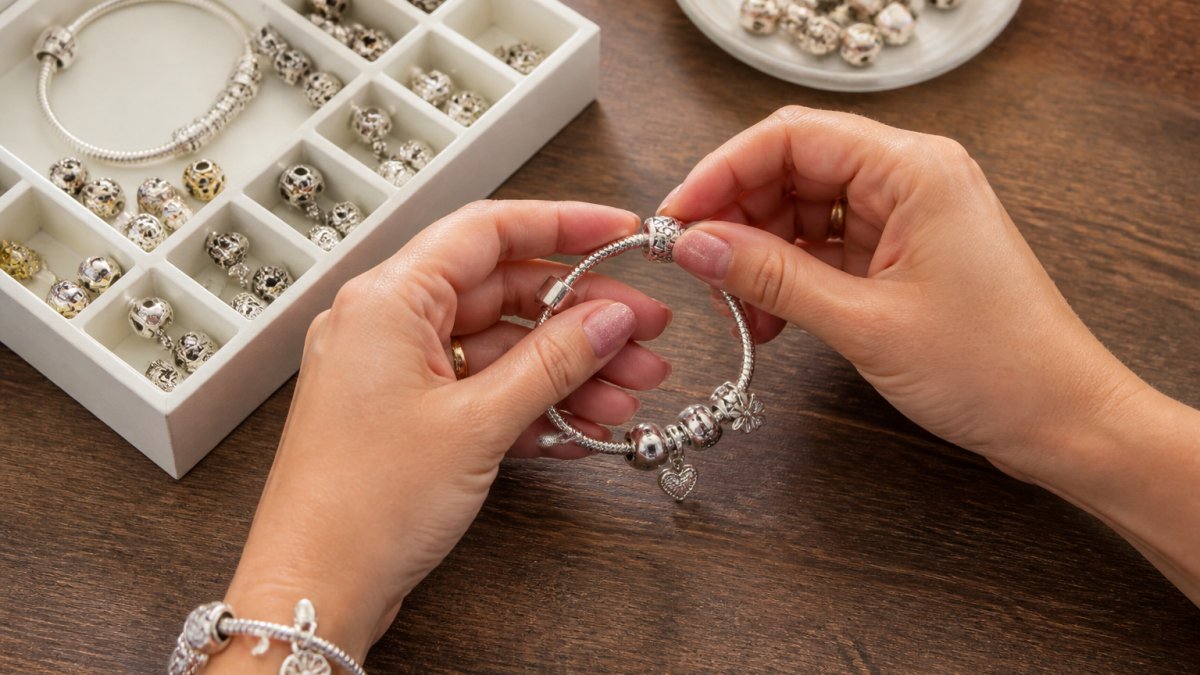
You can attach charms yourself with the right tools. The most common DIY method uses jump rings or split rings to connect charms to your bracelet. Both are straightforward but require care to avoid damaging the charm or bracelet.
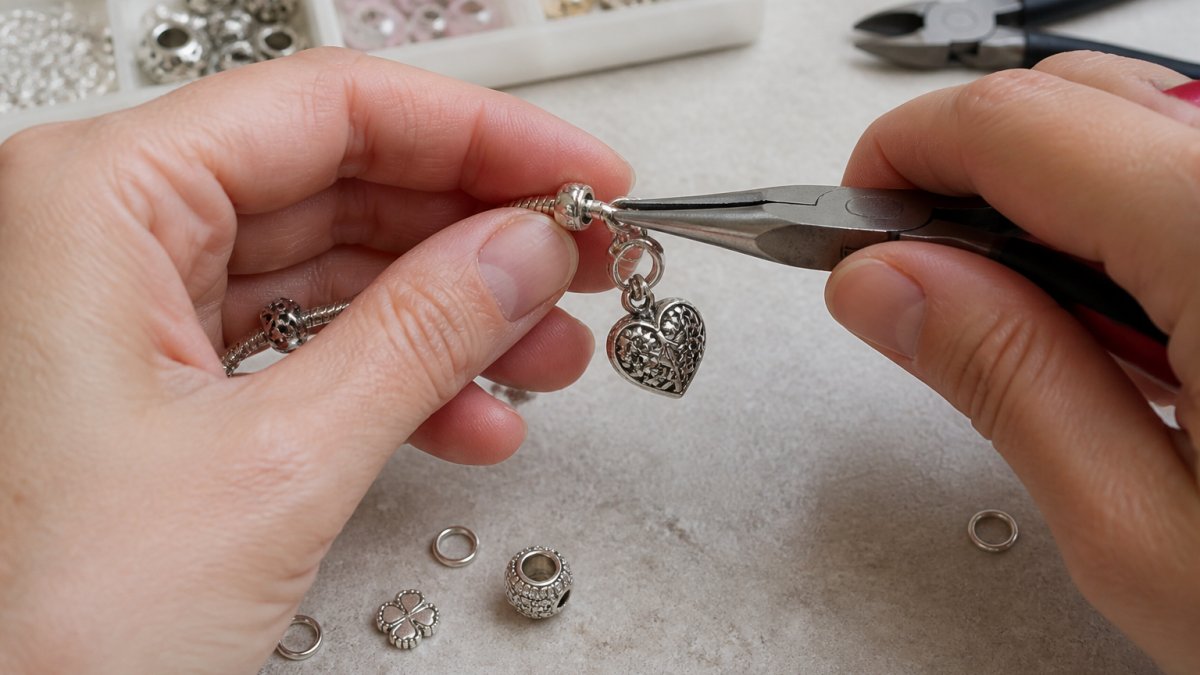
Using jump rings for removable charms
A jump ring is a small metal loop used to connect two pieces of jewelry. To attach a charm, open the ring, thread it through both the bracelet loop and the charm's attachment point, then close it securely.
Steps to attach a charm with a jump ring:
- Hold the jump ring with two pairs of pliers (one in each hand)
- Twist one end toward you while pushing the other end away
- Slip the ring through the bracelet's charm loop
- Thread the ring through the charm's loop or hole
- Twist the ends back together until they align perfectly
- Check that the seam is tight with no gap
This method lets you remove charms anytime without tools, but jump rings wear out from repeated opening and closing, so check them regularly.
Using split rings for secure attachment
A split ring works like a key ring: a double loop of wire twisted together. Split rings hold charms more securely than jump rings because the doubled wire is stronger and less likely to pop open. To attach a charm, slide the ring through the bracelet's attachment point, then use a small hook or the tip of needle-nose pliers to pry it open slightly and thread the charm's loop through.
Why split rings are more secure:
- The doubled wire resists accidental opening
- They distribute stress across two contact points
- They're ideal for heavier charms or daily wear
Tools you'll need
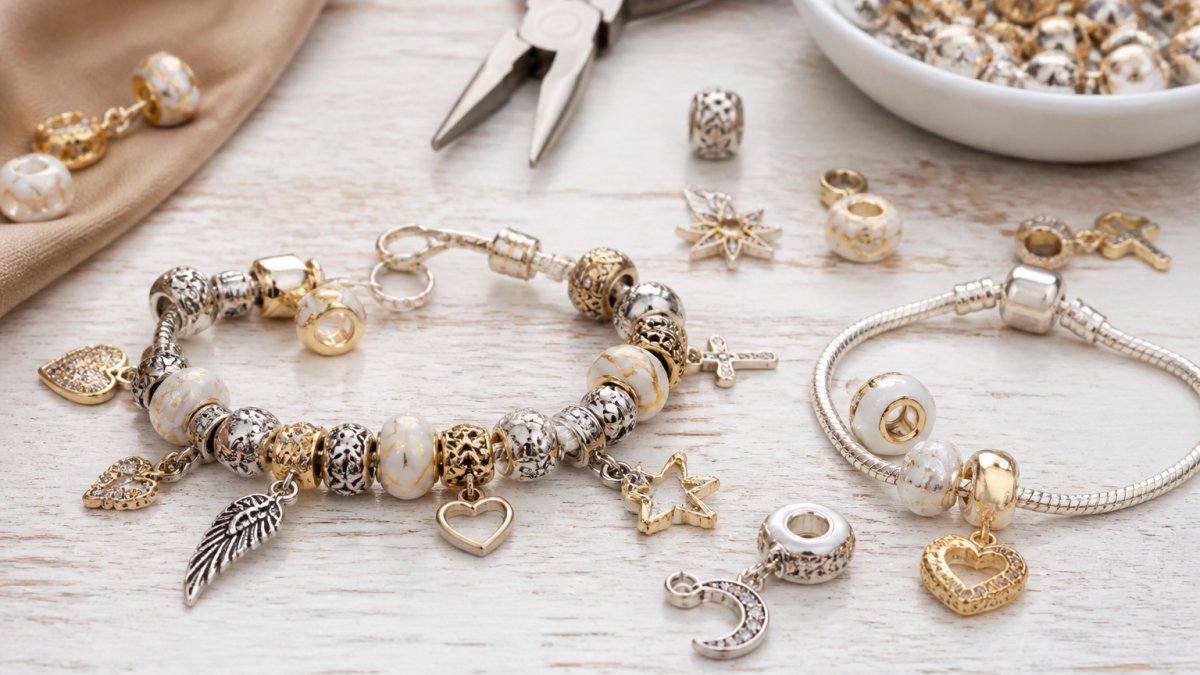
Attaching charms yourself requires only a few basic tools:
- Needle-nose pliers (one pair minimum; two pairs is better)
- Jump rings or split rings in the correct size
- Small needle or pick (to help pry split rings open)
Needle-nose pliers let you grip and twist jump rings without bending them out of shape. With two pairs, hold one stationary while twisting the other to prevent deformation. Using only one pair and twisting too hard can weaken the metal.
Non-Pandora Charms on a Pandora Bracelet: What You Need to Know
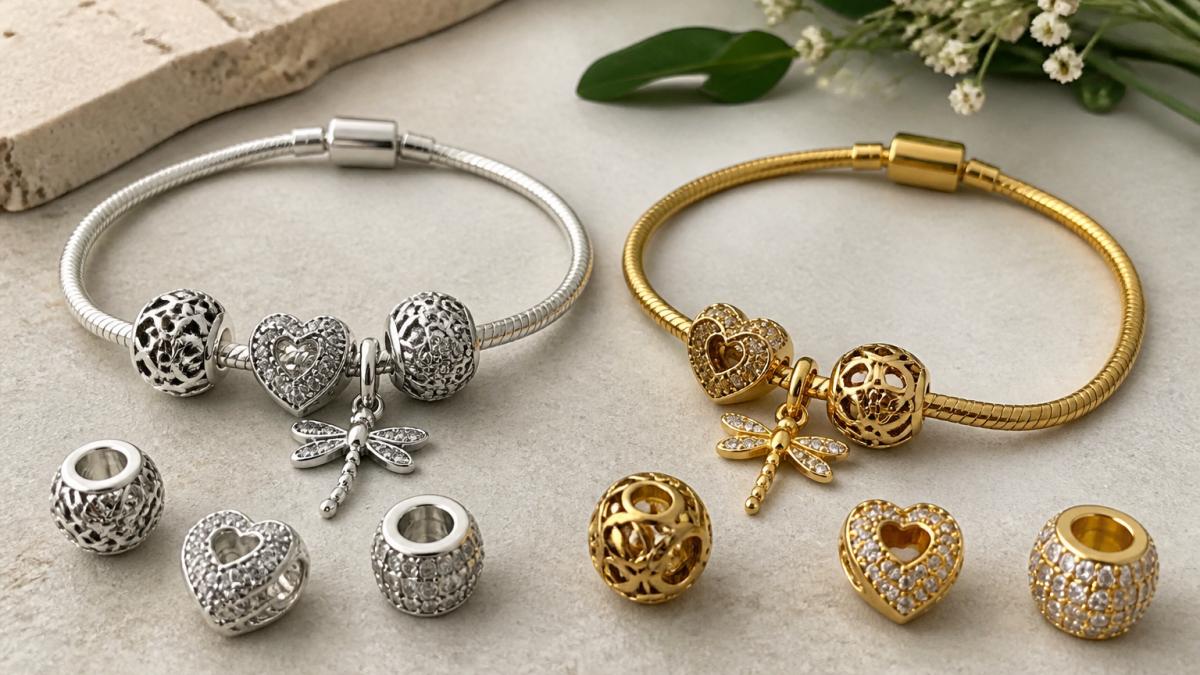
You can add non-Pandora charms to a Pandora-style bracelet, but compatibility depends on the charm's size and attachment mechanism. Pandora bracelets use a barrel clasp system, and charms must fit the barrel's diameter to slide on smoothly.
Compatibility check:
- Measure the barrel diameter (typically 4-5mm for standard Pandora bracelets)
- Check that your charm's attachment loop matches this size
- Test-fit before committing to permanent attachment
The advantage of Pandora-style bracelets is their standardized sizing. Many artisan charm makers, including those creating handmade alternatives, design charms to fit standard Pandora barrels, giving you flexibility to mix and match.
Charm Bracelet with Soldered Links: Permanent Attachment Options
Soldered links are metal loops fused permanently to the bracelet chain, designed specifically for charm attachment. If your bracelet has them, you can attach charms using jump rings or split rings without worrying about damaging the attachment point.
Advantages of soldered link bracelets:
- Built-in attachment points designed for charms
- Support heavier charms safely
- Professional appearance when charms are attached
If your bracelet doesn't have soldered links but you want permanent attachment, a jeweler can solder new loops to the chain at regular intervals.
Bracelet Charm Placement: Where to Position Your Charms
Think about spacing and visual balance when placing charms. Crowding too many together looks cluttered; even spacing looks more polished.
Placement strategy:
- Leave at least one chain link between charms to prevent tangling
- Distribute heavier charms evenly around the bracelet
- Group charms by size or color if you have a specific design in mind
Weight affects comfort and durability. A bracelet covered in heavy charms feels cumbersome and may strain the clasp or attachment links over time, so aim for a mix of lighter and heavier pieces distributed evenly.
When to Visit a Jeweler vs. DIY Attachment
Most charm attachments are a five-minute DIY job. A meaningful minority are not, and getting that call wrong can cost you the bracelet. The decision isn't about how confident you feel with pliers; it's about four concrete factors: the bracelet's construction, the charm's weight, whether the change needs to be reversible, and how much damage risk the piece can tolerate.
The four-factor decision
Factor 1: Bracelet construction.
- Has dedicated charm loops or soldered links. DIY is fine. The attachment point was engineered for this.
- Plain chain with substantial links. DIY is usually fine with a jump ring through a single link.
- Snake chain, omega chain, solid bangle, or finished cord. DIY is not realistic. You need a clip-on bail, a slider, or a jeweler-soldered loop.
Factor 2: Charm weight.
A useful rule of thumb: if the charm feels heavier than three or four links of the chain it is going on, the attachment point is now the weak link.
Factor 3: Reversibility.
- Want to swap charms seasonally or move them between bracelets? Use jump rings or split rings. No jeweler needed.
- Want a permanent, seamless look? Soldering is the answer, and soldering is a jeweler's job. You cannot un-solder at home without risking heat damage to the surrounding metal, especially on plated pieces.
Factor 4: Damage risk.
This is where plated and delicate bracelets change the calculus. White and gold plating is a thin surface layer, and any slipped tool, torch heat, or abrasive polishing will cut through it and expose the base metal.
When DIY is the right call
- The bracelet has existing charm loops or soldered links
- You are using jump rings or split rings, which are removable
- The charm is standard size and weight relative to the chain
When to hand it to a jeweler
- The bracelet is vintage, antique, hollow-link, or high-value
- You want soldered links added to a bracelet that does not have them
- The charm is fragile, enameled, or set with stones that could chip under plier pressure
What to ask before leaving a bracelet with a jeweler
A short conversation up front prevents most surprises.
- What method will you use? Soldering, a soldered jump ring, or a clip-on bail are different jobs with different permanence.
- Will the finish be affected? On plated pieces, ask specifically whether heat or polishing will touch the plating.
- Is the change reversible? If you might want the bracelet back in its original state, say so before work begins.
A note on plated and delicate bracelets
If your bracelet has white or gold plating, treat every attachment as a finish-risk decision. The safest path is a removable jump ring or split ring attached to an existing loop, with no tools touching the plated surface beyond the loop itself. If the bracelet has no loop and you want a permanent attachment, ask a jeweler who understands plated jewelry, because the alternative is a visible scar in the finish that cannot be repaired at home.
The short version
DIY when the bracelet already has an attachment point, the charm is proportionate, and you want the option to change your mind. Go to a jeweler when the bracelet is delicate, plated, vintage, or lacks an attachment point, or when you want a permanent result. A professional attachment is almost always less costly than replacing a bracelet you damaged by guessing.
Common Mistakes to Avoid When Adding Charms
Other mistakes to watch for:
- Forcing charms onto a bracelet with incompatible attachment points
- Attaching too many heavy charms to a delicate bracelet
- Not checking that jump ring seams are fully closed
When opening a jump ring, twist gently to create a small gap, not to bend the ring into an oval. Once the charm is threaded through, twist back until the seam is tight and flush.
Adding charms to a bracelet transforms a simple piece into a personalized story. At Handmade Pandora-Style Charm Bracelets, we create sterling silver bracelets designed to beautifully showcase your favorite charms.
Frequently Asked Questions
Can you add charms to any bracelet?
Not every bracelet can accept charms. Charm bracelets with open links, soldered links, or charm holders are designed for this. Solid bangle bracelets, chain bracelets without attachment points, and some modern minimalist styles cannot accommodate charms. Check whether your bracelet has visible attachment points or a charm holder before attempting to add charms.
How do you attach a charm to a bracelet safely?
The safest methods depend on your bracelet type. For bracelets with open links, use a jump ring or split ring with needle-nose pliers to attach the charm securely. For soldered-link bracelets, a jeweler can solder the charm in place permanently. Always open and close rings gently to avoid damaging the metal, and ensure the charm weight doesn't exceed your bracelet's capacity.
Can you put non-Pandora charms on a Pandora bracelet?
Yes, but compatibility depends on the charm size and the bracelet's attachment points. Pandora bracelets accept charms with standard-size holes that fit onto the bracelet's links. Non-Pandora charms may work if they have compatible hole sizes, but always verify dimensions before purchasing. Some alternative charm designs offer similar aesthetics and fit.
Where should you place charms on a bracelet?
Position larger or heavier charms near the clasp for better weight distribution and security. Alternate charm sizes and styles around the bracelet to balance the visual design. Leave small gaps between charms to prevent tangling and allow the bracelet to move naturally on your wrist. The two-finger rule helps: ensure you can fit two fingers comfortably under the bracelet when worn.